The title, to me, was a punchline. Of sorts.
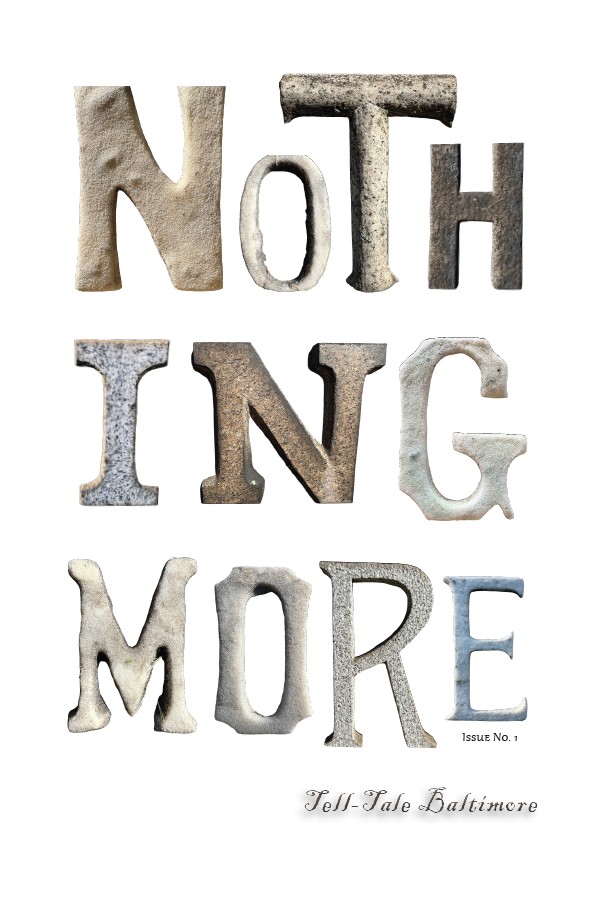
I moved to Maryland in January 2000, and my transplanted Jersey roots (which had only ever really known the loose, sandy soil of the Pine Barrens) took their time taking to the rocky clay of Harford County. Culturally, Northeastern Maryland wasn’t much of a leap from Southeastern New Jersey — thankfully, I still had Wawa — but as a recent college grad, it put me closer to year-round job markets.
More importantly, I was in love.
After a few false starts, I found my footing later that year, when I took an entry-level job in downtown Baltimore, editing a thousand-page, statewide directory for the Maryland legal profession for $22,000 a year, plus benefits. In addition to putting my newly minted degree to work, the job offered a much-needed crash course in my new home’s geography, history, and culture.
My introduction to the city began in earnest at the corner of Fayette and Greene, a crossroads of motley bedfellows. Pillars of the state’s legal community. The University of Maryland Schools of Law, Nursing, and Dentistry. The world-renowned R Adams Cowley Shock Trauma Center. “World-Famous” Lexington Market. The Baltimore VA Medical Center. A methadone clinic. And sleeping it off in the midst of it all, Mr. Edgar Allan Poe, of Westminster Burying Ground.
Five unpaid, one-hour lunches each week enabled me to explore in nuance most of downtown north of the harbor. The “Maltese” falcons adorning the old Continental Trust Company, on East Baltimore, where Pinkerton employed Dashiell Hammett. The 1814 cannonball enshrined nearby, on East Redwood. The notorious Block. The former Hotel Kernan, where Henry Fonda married Margaret Sullavan on Christmas Day, 1931, and much later, hosted punk rock royalty. Lady Day herself headlined the ruined Mayfair while, over on Eutaw, ghostly 10-cent matinees still haunted the Hippodrome. And of course, the human comedy, tragedy, chaos, and character baked into almost every daily encounter. A young child wise enough to steer clear of “the paddy wagon.” A parolee’s lament for a long-gone skyline. A pitch relentlessly two dollars short of that bus ticket home to Pittsburgh. A still life rendered in blood, chalk, and concrete.
I’d haul my quarry back to the office and, sometimes, have the Highlandtown ladies in stiches.
Mass transit made it all possible; where I grew up, driving was neither right nor privilege but necessity, if you meant to eat, work, or play. Each morning, I’d catch the MARC train from Aberdeen down to Baltimore Penn, from there south, via Light Rail, to Lexington, walk the last three or four blocks, and come the end of the day do it all in reverse. I’ve never liked winter, but those fiery-cold twilights coming and going across the Bush and Gunpowder Rivers — a good book and maybe a cup of Wawa in hand — still linger in memory.
I was young then, and the city held wonder. Mystery. Magic. All of which seemedconspicuously absent from the faces of my fellow commuters who stepped out of that long silver tube and onto the cold concrete platform at Penn every morning (never mind the lost, hollow-eyed suits bound for DC). To eyes trued by suburban artifice, Baltimore seemed to come off as nothing short of bent, if not outright broken. Damaged goods.
But, rolling past the scrapyards and industrial ruins, Algren’s homage to his own adopted city — Chicago — often came to mind: “Like loving a woman with a broken nose, you may well find lovelier lovelies. But never a lovely so real.”
Some days, I was frighteningly tempted to slap the first frown within reach and issue a proclamation that would evolve into part personal mantra and part ultimatum: Smile, hon, you’re in Baltimore!
It was never meant to be a series, Smile, Hon, You’re in Baltimore! But then it never dawned on me back then that I’d still be working that same swath of the city’s west side more than 25 years later. Most of those stories were byproducts of my innumerable wanderings downtown and, needless to say, it wasn’t long before I had enough fodder for a follow-up issue.
As I settled into the area, I met people along the way. Coworkers. Friends. Many born and bred, some transplants like myself. All with stories of their own. In time, I convinced a few of them to write theirs down and submit them for a third issue. Then a fourth, and fifth, and so on. During its 15-year run, Smile, Hon’s contributor base expanded from friends to friends of friends, casual acquaintances, random strangers. School teachers. Hairdressers. Booksellers. Cops. Petty criminals, and occasional felons. Black and white. Rich and poor. Young and old. Residents and transients. Some professional wordsmiths, most not. Their stories wove a complex, unvarnished tapestry of urban experience whose appeal proved universal enough to garner acclaim well beyond the Baltimore area. In the process, I met some outstanding human beings, many of whom I’m honored to call friends to this day.
Life got bigger, too. I got married. Bought a house. Had a kid. Survived cancer. Smile, Hon chugged along through it all, that was until circumstances beyond my control sent my longtime work-life balance into a tailspin. But for those 15 years, I made it work — 30 issues in all — thanks to the love and support of close friends and family, most of all, my partner and best friend, Davida.
Smile, Hon, You’re in Baltimore! went on an unceremonious, indefinite hiatus 10 years ago. After taking a few years off from publishing, I launched Beach Badge, a zine dedicated to creative non-fiction about the New Jersey Shore, in 2022. At some point over the last decade, the occasional inquiries concerning when I would publish the next issue of Smile, Hon shifted imperceptibly to if.
To be clear, I was never against producing another Baltimore-based zine. Hell, Baltimore is now as much a part of me as Jersey ever was. More so. But it had to be something else. Something different. Something new. Because let’s face it – the view from 50 looks a hell of a lot different than the one from 25, especially after the last 10 years. And Smile, Hon, to me, was very much a product of its time. The city looked different then. Its faces and neighborhoods. The people. Relationships. Media. Government. And not just here but all over. The state. Our country. The whole goddamned world.
All of which are still here, of course.
But different times call for different measures.
Time and practice have made me a better editor and writer, I think, if not a particularly great or prolific one. But Nothingmore, like Beach Badge and Smile, Hon before it, is no less a passion project. Sure, it’s nice to break even. Channel an accidental profit into a full-color cover or bigger print run. But frankly, the greatest dividends from a quarter-century of self-publishing come not from my own words but rather in bringing together an otherwise unlikely stable of voices. Some who occasionally thank me for publishing their work before they knew for themselves that they were writers, others for encouraging them to tell their story, in their words, for the first time since high school…or, in some cases, ever.
While a few of the bylines in Nothingmore may seem familiar, let me assure you they are not the same people who once graced the pages of Smile, Hon. Like so many friends, Romans, countrymen, they, too, have seen some shit in the last 10 or 20 years of our lives. Anxiety. Hardship. Grief. Recession. Depression. Pandemic. Fascism.
Nothingmore is a tangible record of renewed hope.
It’s not the world of John Waters or Barry Levinson. Nor is it that of Anne Tyler. Or Simon or Mencken or Poe. Rather, Nothingmore leans into the lived experience of a dozen unique voices in a city that’s always had to work a little harder and do more with less. Without romance or judgment. Forgiving, yet not forgetful. All lump, no filler.
And you don’t need to be from Baltimore to appreciate that.
William Patrick Tandy
November 2026

