Words by Joseph O’Sullivan
Photos by Michael McCarthy
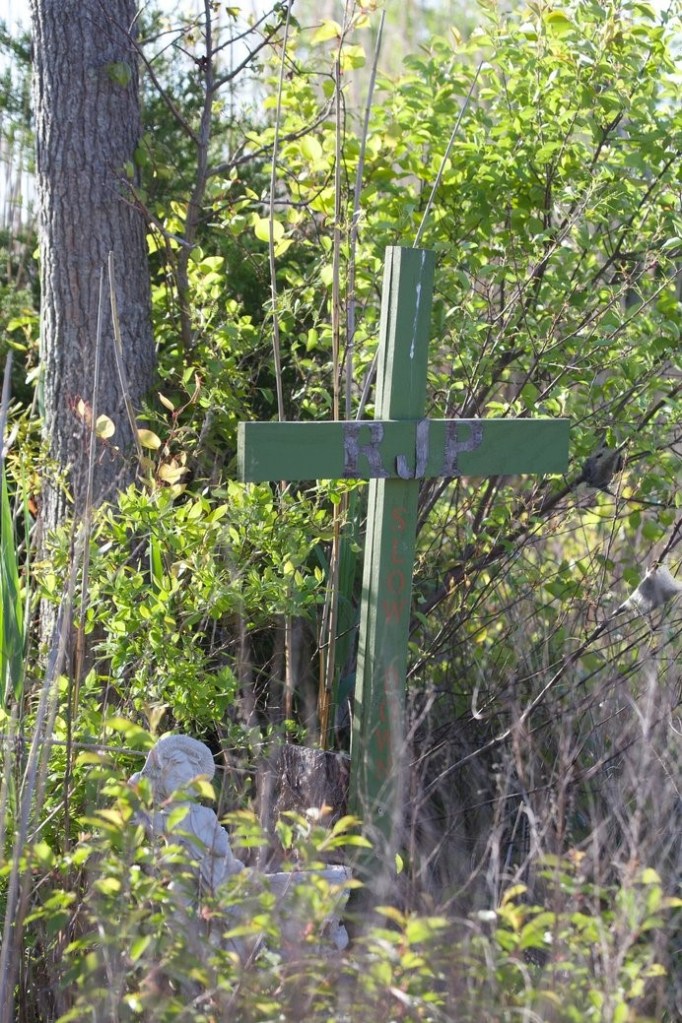
YOU KNOW YOU’RE ON the right dead-end road when you pass Jennifer Lynn Russo’s cross. On the left side of the marshes, its slender green wooden arms blending into the foliage, marking the moment in ’95 where the car went into the creek, killing the 17-year-old. Russo’s cross has always been part of my landscape: My first drive back here would have been a year or two later.
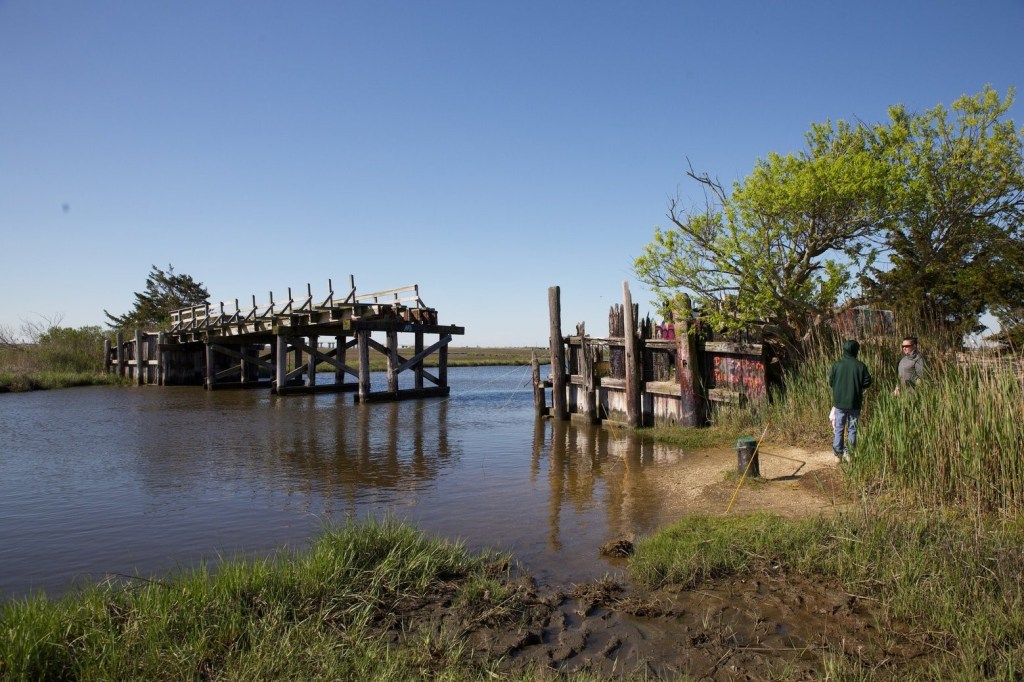
From her cross, the crumbling strand of pavement runs straight through the estuary, waterways to either side of the marsh beyond peeking reeds. Everything above is sky until you slow at the end, where a low rise hoists a narrow, half-section of wooden bridge into the air, bird-dogging toward Long Beach Island (LBI) out distant.
It’s a perfect spring day. The blue of the sky deepens and deepens the higher you look, the reeds dance to a light breeze that sends ripples along the creeks. I leave the car and feel the wind as I look across the marshes. Out on the Causeway, I watch trucks soar across the bay. Plumbers, roofers, framers, crawling silently toward the Long Beach Island summer homes in need of attention. I’m in one of the only spots in Manahawkin that offers true solitude – at least until the next car rolls up.
The Bridge to Nowhere never went anywhere that we knew. First built in the late 1800s, some wanted this to become a railroad bridge to the island. After World War II, it was seen as a possible access point to grind up more estuary and build another network of lagoon neighborhoods. [For more on the shore’s lagoons, see “Lagoon Life” in Beach Badge No. 6.]
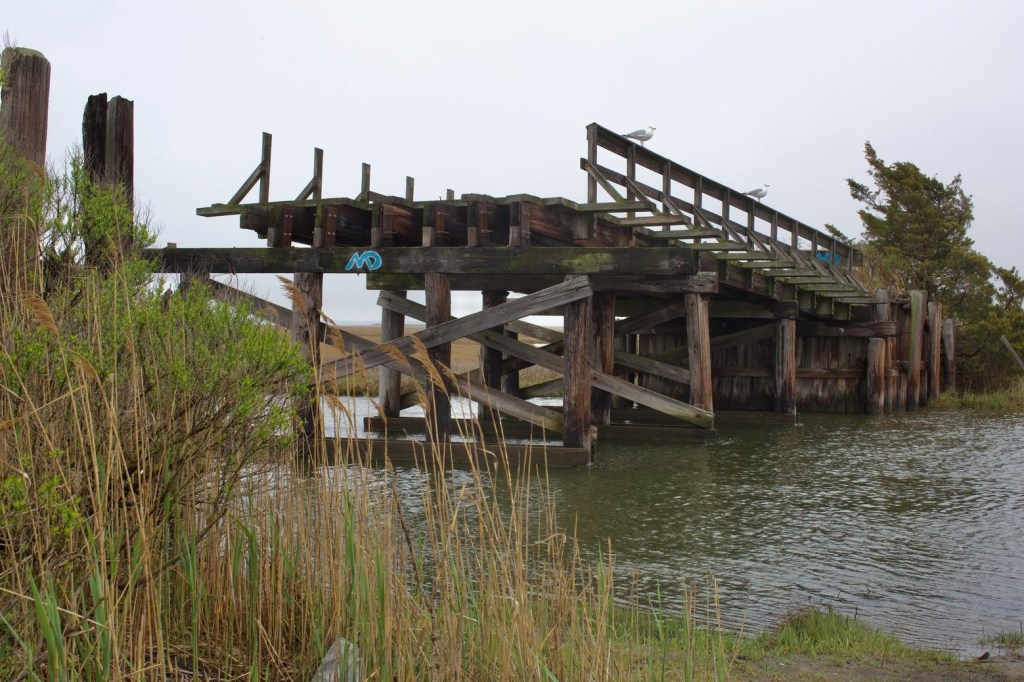
I remember walking the bridge’s cedar planks in my youth, leaning against the waist-high railing and looking north at the miles of marshlands. Sometime after my college years, a fire burned out the bridge, erasing the near-half of its span, so it’s not really even a bridge anymore. More like Nowhere, Squared.
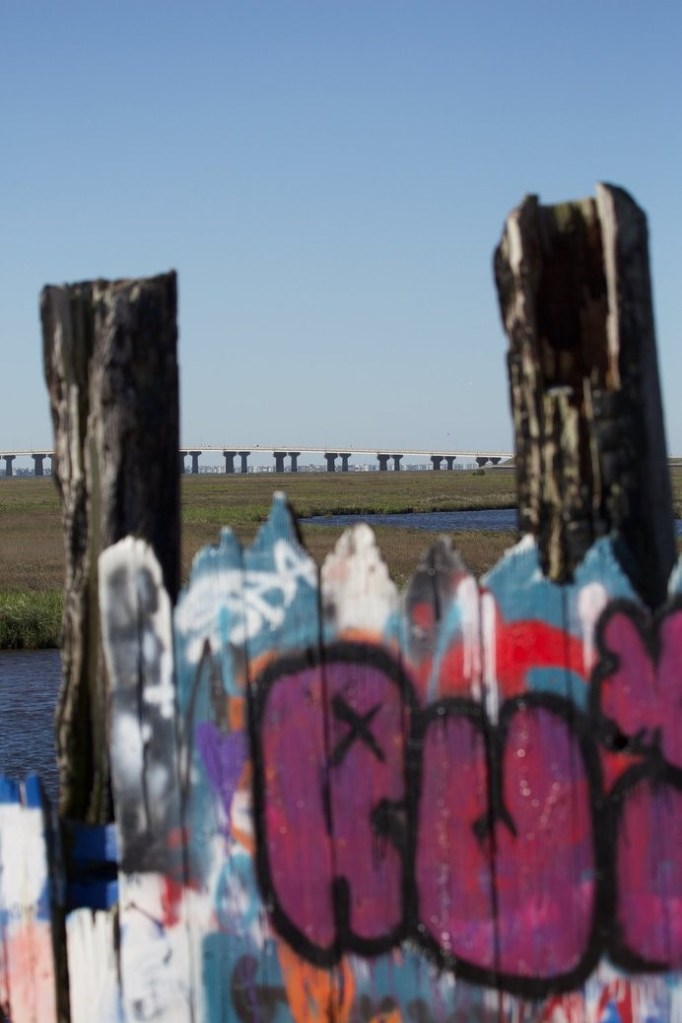
Since that blaze, we’re left looking across the gap to the far side of the span, its cindered cedar planks jutting hard into the low sky, a bleak refuge for shorebirds, brutalism for seagulls. The remains on the near-side – wooden foundations, jersey barriers to stop vehicles from plunging into the gap – are laden with ever-changing graffiti.
But there’s still the view. Off to the left, Barnegat Lighthouse, a pre-Civil War engineering marvel, rises like a miniature red candle. To the right, the graceful arc of the Causeway. Behind me is nothing but unspoiled nature. All around, the silence, punctuated by the chatter of insects, the squawks of gulls. An egret swoops by, big wings a-whooshing.
Here, it’s hard to be alone in New Jersey, the nation’s most densely populated state. Approximately 1,260 souls huddle together in each square mile, penned in by the largest and sixth-largest cities in America. Down the shore, the Atlantic Ocean hems us in even as it attracts moneyed hordes of Pennsylvanians and New Yorkers. Wherever you are, traffic, noise, and busyness are imposed upon you.
Not at the Bridge to Nowhere. I breathe it in, feel its peace enter my nerveways. Then, I hear a rumble down the road. Here comes the next solace-seeker.
When we get out there one April morning, to gather material for this photo essay, Michael and I wonder if anyone will be around. The bridge these days draws a constant, low-grade trickle of folks. Crabbers, fishers, kayakers, smokers, people in beat-up trucks with large dogs, young lovers.
Today, there’s a woman standing by a random folding table, and Michael chats with her. I start my review of the bridge by conducting a routine graffiti check. A few months ago, I found anti-trans messages among the explosion of tags and colors that drape the jersey barriers and wooden foundations.
This time, I spot the N-word atop one of the jersey barriers, along with scattered sex jokes and a painted dick. Down by the base of the wooden structure, there’s a swastika scrawled in blue. The graffiti is the continuation of the Jersey Shore’s long, dark history as a refuge for the Ku Klux Klan and various hate groups. [For more on the Jersey Shore’s history of hate, see “The House on Pacific Avenue” on page 57 of this issue.]
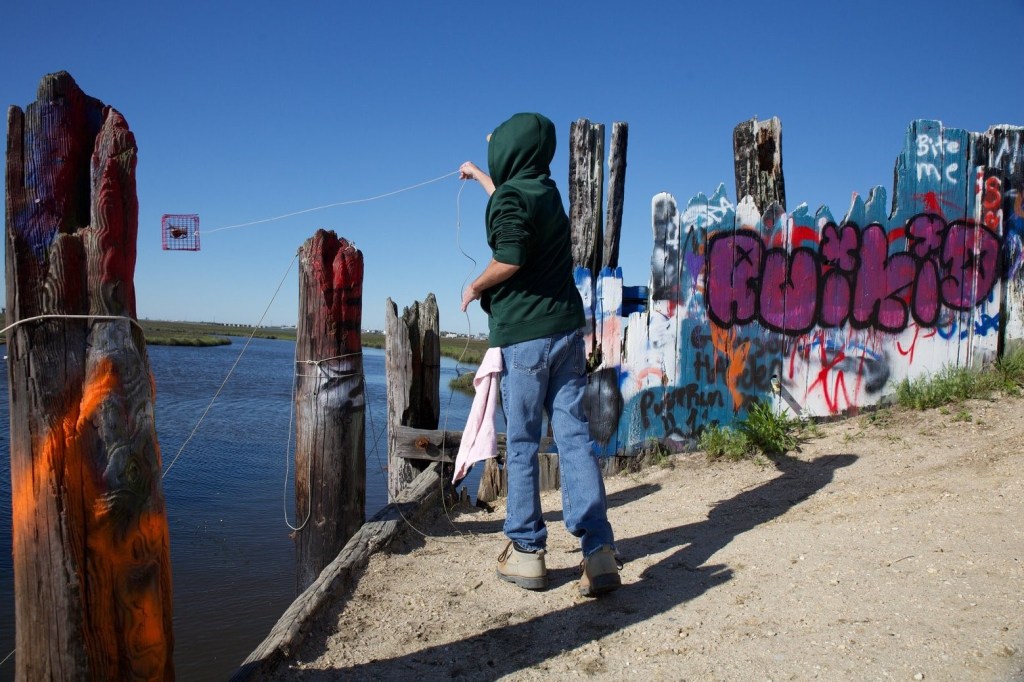
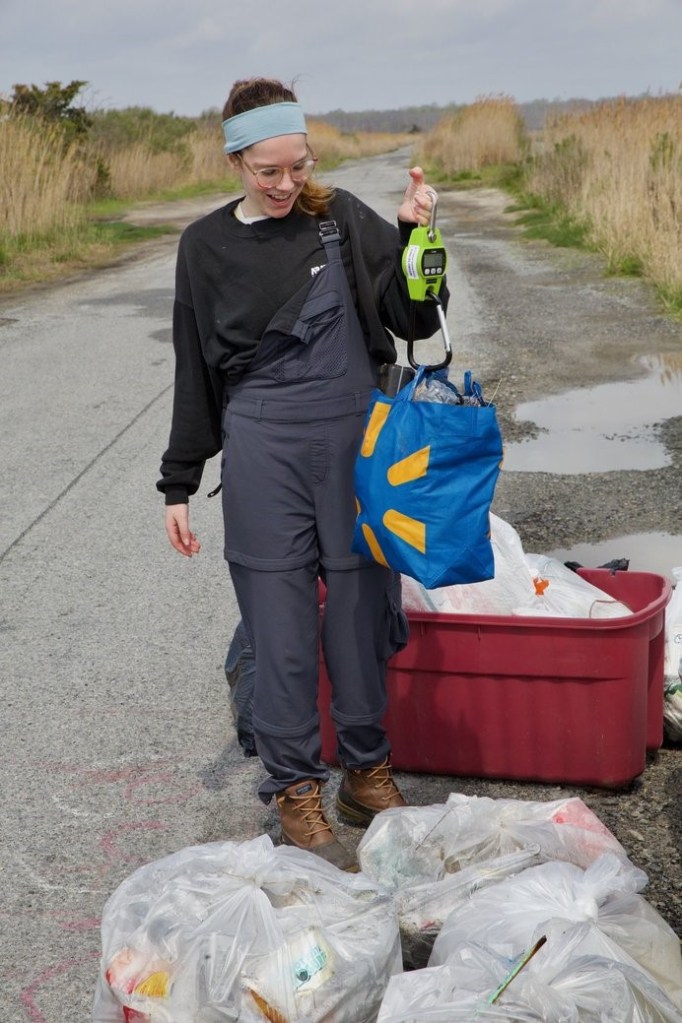
Back down by the car, we chat with Brittany McLaughlin, an executive assistant and community engagement coordinator for the conservation group Save Barnegat Bay. It’s a town-wide volunteer trash collection day, and McLaughlin is leading the efforts at this outpost.
“I think it’s beautiful and wonderful that there were conservationists that, growing up here, living here…worked to preserve our wetlands, which is our most important ecosystem, ” McLaughlin says as she waits for her volunteers to arrive. (The Barnegat Bay watershed encompasses a broader region that includes Manahawkin Bay.)
A 26-year-old McLaughlin grew up in Manahawkin. This is her second or third time here, at the Bridge to Nowhere: “I heard about it when I was in high school, I just never went.”
I’ve thought a lot about my trips here, or tried. It’s all a flicker, blurry, partial montages. Sitting in the back of someone’s else car, before I could drive, bumping along the potholes. The creak of the wooden planks on the bridge, leaning against the chest-high railing to smoke a cigar. Later, in my 20s, I remember parking and making out with an old flame against my truck.
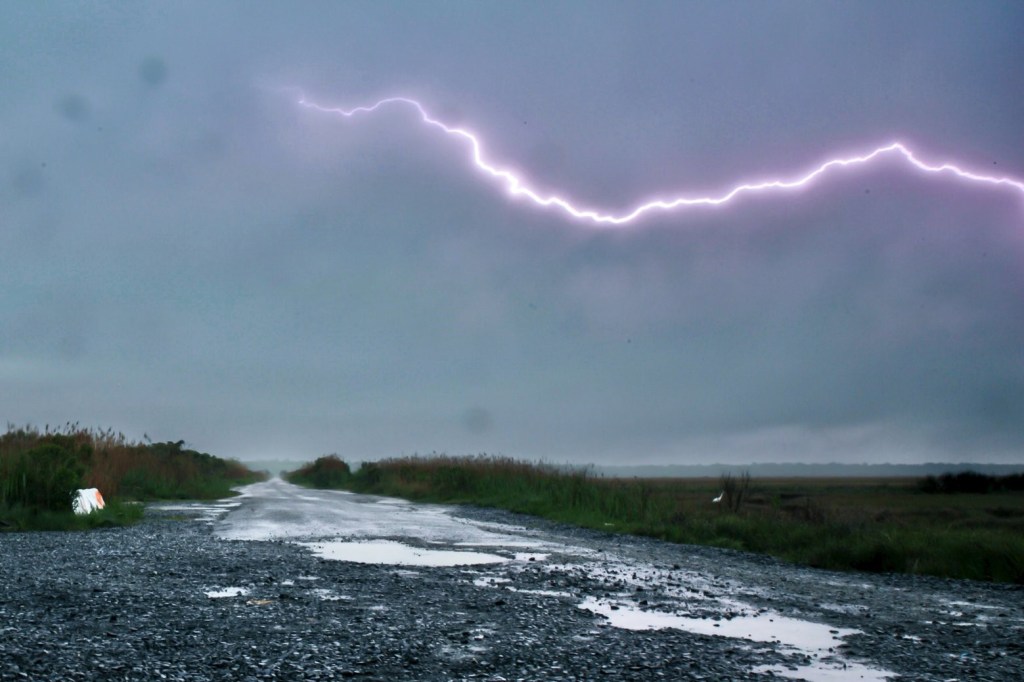
Everyone else I ask about the Bridge to Nowhere shares that haziness. Michael, whom I met in first grade, vaguely remembers going there a few times when he was young, including one trip with his mother to what he believes was the Bridge to Nowhere, to see a lunar eclipse.
I text my old flame, and other than our escapade, the “only thing I remember from back then is a few friends having a shopping cart hidden along that road and I believe them having shopping cart races.”
I ask another friend if she went there in high school. “I’m not sure,” she texts back. “I think I did, but it’s very vague.”
Yet another replies: “We used to drive down there when we were bored in high school, always kinda creeped out knowing that girl died in that car accident near there.”
My mother remembers Bridge to Nowhere. After I left for college, she and my father came here to crab by hand lines, in the year before he was diagnosed with cancer. I text her a photo of the bridge, and she responds with a frowny face. She hadn’t seen it since the fire and graffiti.
The historical plaques dotting Stafford Avenue, the wide, empty downtown boulevard leading to the Bridge to Nowhere, tell the early story. In 1871, General William Grier, a Civil War cavalry veteran who was wounded at the Battle of Williamsburg, bought up land with his son and developed the road.
“They hoped that Stafford Avenue would become the thoroughfare to Long Beach Island,” reads the plaque outside Cavalry Cottage, a small, ramshackle structure from the 1740s believed to be the oldest house in Manahawkin. It played home to Grier and his son during those years.
The project fell through; the railroad – itself now long gone – was eventually built along Route 72, the highway where the Causeway now crosses the bay to LBI.
A 2023 report in Jersey Shore Online cites the appearance of the Bridge to Nowhere on a federal registry in 1871, and that the bridge was rebuilt at least once. In the mid-20th century, developers again eyed the area as an additional route to Long Beach Island, perhaps anchored by a network of lagoons like nearby Beach Haven West.
According to a woman whose father was a local general contractor, “the intended function of the new bridge was to connect with a similar development on the opposite side of the bay,” according to another report in Jersey Shore Online. “However, the project never materialized, and numerous individuals have attributed its failure to the perceived impossibility of construction due to more stringent environmental regulations in that area.”
One day in mid-May, I break from a crawl of vehicles on Route 72 to merge into another crawl on northbound Route 9. I pass through the traffic light where two streams of cars messily smoosh into one, and bank right onto Stafford Avenue. Instantly, my car becomes the lone vehicle navigating our blessed, fading downtown, traveling through my own personal history.
The spot where my friend pulled over in high school to examine a fresh roadkill raccoon. The wooden house that used to be our small-town library, where my mother brought me before I was old enough to read, now the local arts association. The Methodist Church, the oldest in town, built in 1874 from a tract of Grier’s purchased land. Situated next to Cavalry Cottage, it is rumored to have been built in part from shipwreck timber. Farther down, the former home of a childhood friend, its front yard studded with trees; I scraped my ’68 Dodge against one of them late one night around the turn of the century, while sneaking over to tap on her window.
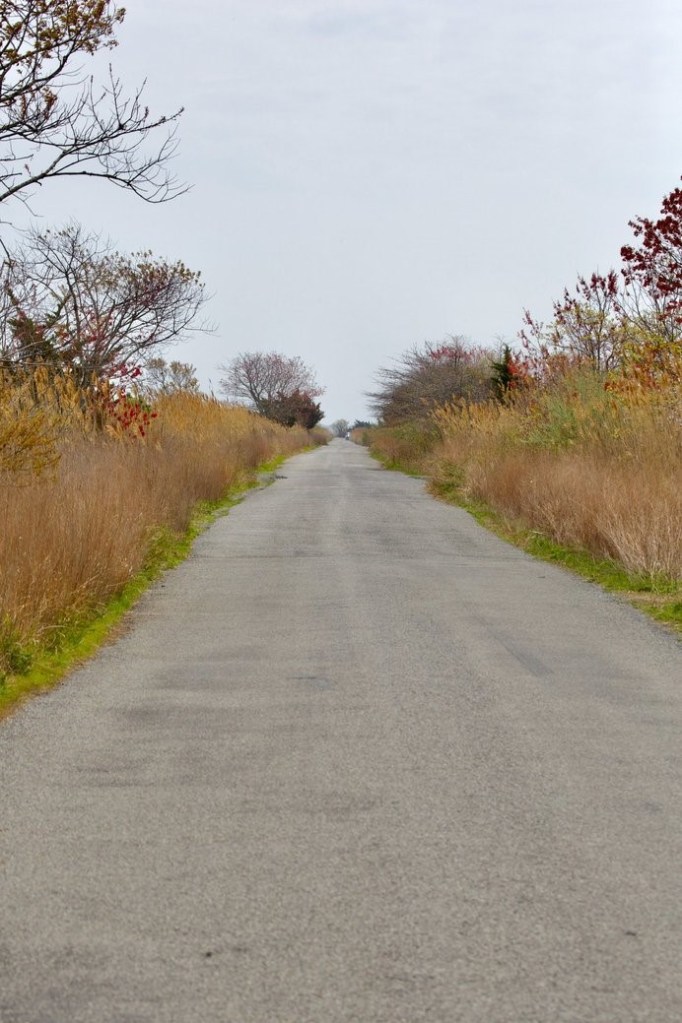
From there, buildings thin out. I accelerate, rolling through hardwood forest that glistens after the spring rains. I cross a final intersection, where a desultory old municipal sign declares we’re being surveilled and will be prosecuted to the fullest extent of the law for whatever we might have done – classic Jersey Shore cop stuff. The pavement starts to crumble, each successive pothole expanding until the road breaks for a spell and you slowly inch through the ruts. Above, the canopy closes in, allowing only a jagged streak of sky through a tangled curtain of green.
I hit the bend, curve right, and leave the forest behind. My windshield is an explosion of reeds and a big, broad sky of shading blue pocked by a handful of the whitest, puffiest clouds. I look for Russo’s cross – there she is – tucked into the flora. I lift my fingers off the wheel in salute, hit the accelerator, and wonder what awaits me today at the Nowhere, Squared.
***
Joseph O’Sullivan is a writer and journalist who was born and raised in Manahawkin, NJ. He graduated Southern Regional High School in 1999 and is back in town after 20 years living west of the Mississippi. Find him on socials: @Olympiajoe.
Michael McCarthy stands where the Atlantic meets the Jersey Shore, a man with a camera and an eye for moments that most people pass by – the rawness of a storm, the light on a fisherman’s hands, the way the sun spills across an empty boardwalk at dawn. His work is eclectic because life is eclectic, and he shoots as he lives – unpredictable, a little rough around the edges, but always honest. Find him on Instagram: @alonefirearts_photo_blkandwht.
 Eight Stone Press