By Joseph O’Sullivan
I’VE PARKED MYSELF in the sand at Ship Bottom, watching a procession of waves unfurl under a naked winter sun, when I spy a beachcomber in the distance, waving a device back and forth. It shakes loose a shred of memory: walking the beach with my mother, probably in the late-’80s, with a metal detector of our own.
A hunch: I suspect we still have our metal detector, though I haven’t seen it in at least two decades. Superstorm Sandy pushed two feet of water into our house, fatally contaminating many of our possessions. Whatever had been tucked in our attic, however, survived – generations of family Christmas decorations, cat carriers, baby clothes, my mother’s stores of yarn skeins. Later that day, I climb the rickety pull-down stairs and heave myself into the dim storage space, and my instinct is confirmed. There, resting on a bed of pink insulation, is the black plastic case that holds a now-antique Coinmaster 2900.
The top of the disc is stamped “White’s Electronics of Sweet Home, Ore.”, a company which for decades built fleets of detectors before shuttering at the onset of the pandemic. I’ve never been to Sweet Home, but it’s about 200 miles from where I would usually be right now in Washington state.
I left the Jersey Shore at 23, after my father’s death from cancer, after dropping out of college, and still a couple years away from quitting alcohol and starting to get my shit together. I headed west in ’05, working and finishing university in Minnesota, and then gradually drifting farther – South Dakota, Wyoming, and Washington.
After nearly 20 years away, I’m back in Manahawkin, caring for my mother through her cancer. I’ve been told by my employer I can’t work remotely. And so between errands, meal prep, chemotherapy, and doctor appointments, I sit here at the beach, watching the waves. I wander our town and Long Beach Island and poke around the family home, taking stock of what’s gone and what remains.
I pull the Coinmaster down and look it over. The device is comprised of an aluminum arm that terminates in a searching disc. It is topped with a blue metal control box that sprouts a handle so you can wave it along the ground. Four dials and a push button on the handle govern the box, which also contains a battery light and headphone jack.
A vague recollection: staring down into the bleached, pillowy sands of LBI while using it a couple times, maybe around third grade. I ask my mother and she says we only ever found a couple bottle caps. After that, the Coinmaster found itself in a restful early retirement, the universal fate of so many rock tumblers, telescopes, exercise bikes, and other technologies.
Our Coinmaster’s instruction booklet is lost to time. I go online and dig up an archived PDF manual for the device. The volume knob is self-explanatory, and the rest of the instructions are about as esoteric as the detector’s other dials: Discrimination, Ground Adjustment, Tuner. Reading through, I appreciate the manual’s enthusiastic vision for my new potential life:
“Ahead of you lie exciting experiences you’ll never forget. For years to come you’ll have yarns to spin about the places you’ll visit, the people you’ll meet, the history you’ll learn, and the treasures and relics you’ll uncover. We envy your journey and wish you every success.”
The discrimination knob filters out undesirable objects. On the instrument’s metal display it lists Salt, Nails, and Foil, along the range of its tuner. If I set it to 5, the machine will tune out nails and other junk, but coins will come through. So far so good: I might need those coins in the coming months.
And then there’s Ground Adjustment: this sets the detector’s sensitivity to minerals in the ground, like salt. Banging around the shore after two decades’ absence, I’m sensitive to the ground.
I spent my youth tromping through the pines, creeks, and marshes that permeate our bayside town, our gang of friends always on a new expedition or game of manhunt. Pushing through bramble, lingering in open fields, stalking creeks and lagoons, pedaling our bikes along sandy dirt trails, and collecting our own treasures. One year we found an empty treehouse, other times it was fired shotgun shells, discarded dirty magazines, an abandoned car, a pipe bomb. (I persuaded my friends to toss the bomb in the river rather than set it off in the woods – how responsible of me). I’ve tried to go back and see some of these places, but some are no longer passable. Low-lying patches of forest surrounding the estuary and creek are now frequently flooded and swamped for months on end – something we never saw in our youth beyond a few days a year.
This January, a storm and tidal surge brought water all the way to the edge of our development’s road along the estuary – something else I’d never seen growing up. A man pulled over as I photographed the inundation and I remarked that I had not seen flooding like this.
“Welcome to the bay,” says the man, who would not have known I pedaled this road relentlessly throughout the ’80s and ’90s, likely long before he moved in. A few minutes later, I noticed a cop resting in his cruiser along the road and asked him about the water levels. “It always floods back here,” he said. Except that it didn’t always.
I drive near-daily along Long Beach Island, where intersections in Ship Bottom and Long Beach Township routinely pool with standing water. On multiple side streets, the pavement lingers underwater for days or weeks. One day, the four-lane main road is restricted to its two inner lanes, its outer lanes almost completely submerged. In another few decades, will this road be passable at all?
The Coinmaster has another esoteric knob: the Tuner. Per the manual, this one sets the metal detector’s threshold, defined as “the detector’s maximum operating sensitivity.” I don’t understand what this means in any practical sense. But I am sensitive to the threshold here between past, present, and future.
The shack that rested off to the right on the drive to LBI, the Quelle, and the Dutchman’s of Cedar Bonnet Island, all whacked by Superstorm Sandy. Gone even before that: empty roads on winter days, like driving up Route 9 and not passing another soul till Barnegat. Likewise vanquished is affordable housing, as the charming old bungalows populating the lagoons and coast are demolished to make way for two- and three-story lifted McMansions, with first-floor garages for the Mercedes and Teslas whose license plates shout New York, Pennsylvania, Anywhere But Here.
In Manahawkin, the forests lining Route 72 have shrunk as developers clear them for strip malls that blossom, briefly, before falling into abandonment. They then often sit deserted for years more, even as other forestland is erased to erect other new strip malls that will also soon languish. It’s boom-bust not as a cycle but as a singularity.
Whatever the Coinmaster’s capabilities, it can’t help me find my father’s leather tennis bag, which disappeared even before the storm. Or his wedding ring to my mother that a cleaning person later stole for drug money. Or the sky-blue push-scooter I had in third grade, and left too close to the curb once on a trash collection day. It won’t retrieve my front pages and bylines from the newspapers I wrote for in South Dakota and Wyoming early in my career. I’d mailed them home in cardboard boxes shortly before Sandy, where they sat on the floor and soaked up their own little corner of the surge.
I can still find the pleasures that remain – often the sweetest of surprises – or that have sprung up since my leaving.
I buy papers and coffee from the man who sold my father cigars when I was growing up, who still helms the register of the corner store he owns in our neighborhood. On the same block, I can eat the best pizza on earth, from a baker who’s been tossing pies since I was in grade school.
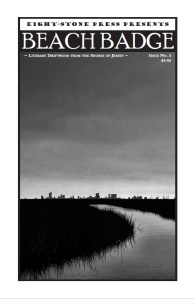
There’s the rural majesty of the Batsto Mansion, the steps of which I climbed one day for the first time since childhood, and the meandering trails of Wharton State Forest. Summiting the top of Old Barney, beating against the sky with its fresh paint, on flawless days, is sublime as ever. Asbury Park still retains some of its majestic ruins, for now. Driving south to meander through a half-abandoned Hamilton Mall, I found a CD/vinyl store, with stocks of Kim Gordon, Tame Impala, Dropkick Murphys, and Mephiskapheles. And here now comes Beach Badge, a publication (finally) devoted to telling our stories.
It’s enough treasure to propel my search forward. A week before the Super Bowl, it’s 32 degrees on Long Beach Island – just cold enough to chill my knuckles on the handle of the Coinmaster 2900. I had to shimmy a knife into the battery pan, to separate an ancient, corroded 9-volt (hello, old friend) that had fused itself to the battery attachment’s snap connectors.
Now, the reckoning: will it seek? I pop in a fresh battery, flick the volume knob and watch the red light on the instrument bank flicker, my breath catching in the chasm of an instant before the answer. The light glows, a spray of dim static registers through the plug-in headphones.
The faint, high-pitched buzz fills my ears as I shiver and sweep the disc across a vacant winter beach. I fiddle with a quartet of knobs, no closer to unlocking their nuances. I drop a quarter on the beach, play the knobs for silence, and run the disc-like band over it. A faint buzz…
The Coinmaster 2900 is on the job.
 Eight Stone Press